


.svg)

.svg)


Testing
Step-Level Validation: How to Move Beyond Pass/Fail on Your Synthetic Tests



Automated testing to validate user experiences across real devices, networks, and channels.



Mobile Money services are expected to operate 24/7. This is a well-known reality for teams responsible for building, running and supervising them. In many markets, these services are part of everyday life and are used repeatedly throughout the day, often in environments where alternatives are limited.
Availability therefore remains a natural priority. Infrastructures are monitored, APIs are supervised, and incidents are handled seriously. Yet in practice, these indicators do not always reflect the quality of experience actually perceived by end users. This is particularly true in Mobile Money ecosystems that rely on multiple channels and are strongly influenced by mobile network conditions.
Summary
1.
When availability does not fully describe user experience
2.
A user experience built across multiple channels
3.
Observing the experience as users actually live it
4.
The role of real network conditions
5.
Building a shared understanding of user experience
6.
Key takeaways for Mobile Money teams
7.
Putting this approach into practice with kapptivate
8
9.
10.
From a technical standpoint, a service may appear fully operational. Systems respond as expected, dashboards remain green, and no critical alerts are triggered. At the same time, the user experience can degrade.
This may result in situations such as:
These situations are familiar to Mobile Money teams. They tend to be intermittent, difficult to reproduce, and highly context-dependent. In many cases, they are first reported by users through customer support before becoming visible through monitoring tools.
This does not point to a lack of expertise or insufficient operational discipline. It rather highlights the limits of assessing user experience solely through technical availability metrics.
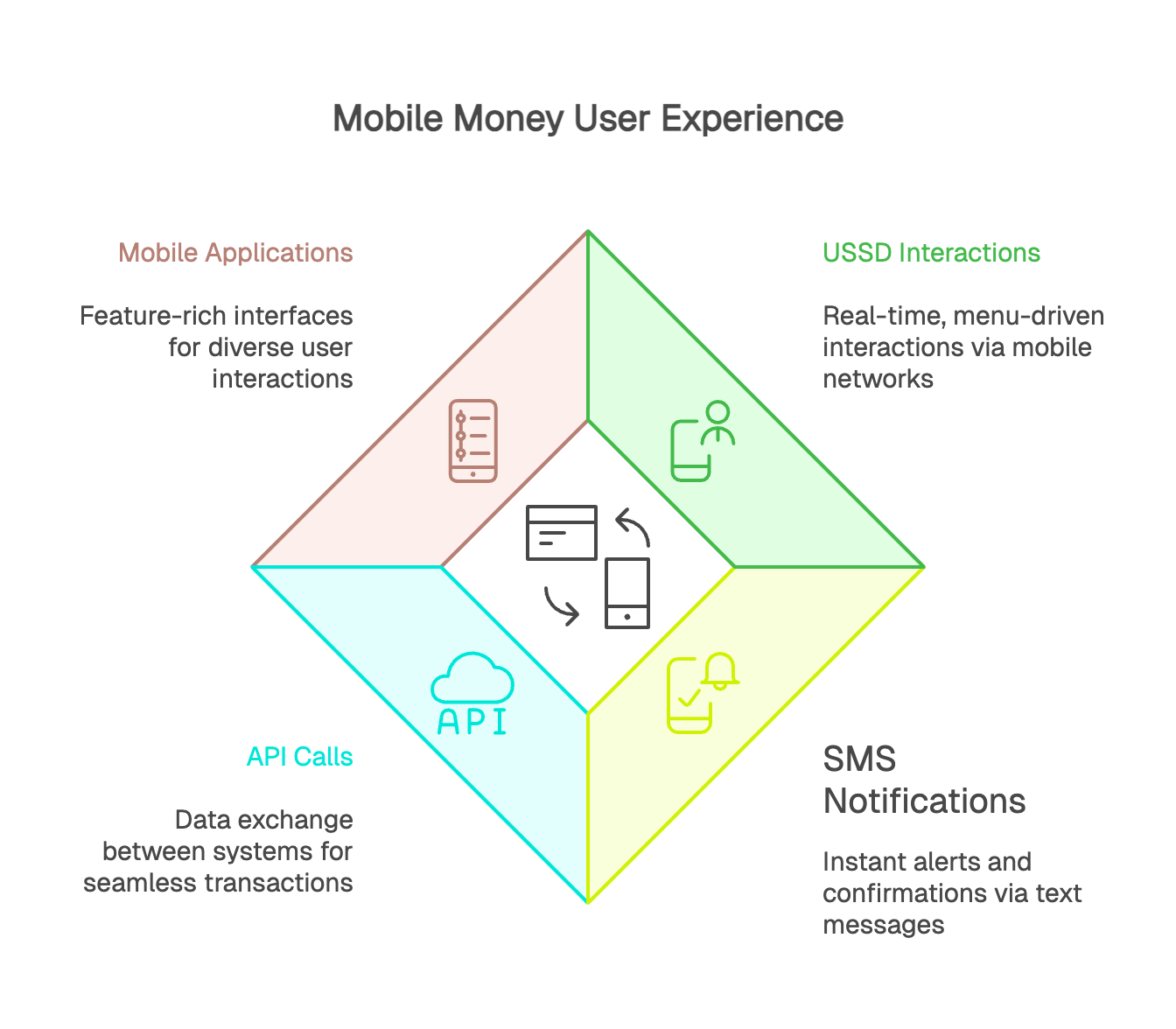
The Mobile Money user experience rarely depends on a single component. It is usually delivered through a combination of:
Each channel comes with its own constraints. USSD flows are sensitive to latency and network behavior. SMS delivery depends on intermediate infrastructures. APIs are often well monitored but represent only part of the overall experience. Mobile applications introduce additional variability related to devices, operating systems and versions.
When observed individually, these components may appear stable. User experience issues often emerge in the way these steps connect and unfold, where real user journeys take shape.
To better understand and qualify user experience, some teams complement their existing monitoring practices with an approach focused on observing real user experience in action. The objective is not to replace traditional supervision, but to enrich it.
In practical terms, this involves executing representative user scenarios end to end and verifying that each step behaves as expected from the user’s perspective. A balance check or a money transfer, for example, is followed from initiation to final confirmation, taking into account responses, timings and messages returned.
Over time, this approach helps make sense of behaviors that are otherwise hard to capture. Intermittent issues become easier to contextualize. Gradual experience degradation is easier to distinguish from isolated incidents. Analysis relies on concrete execution data closely tied to real usage.
In Mobile Money environments, especially for USSD and SMS-based services, user experience is closely linked to mobile network conditions. Latency, congestion and routing variations directly affect how interactions unfold.
Even with stable backend systems, user experience can vary depending on geography, operator or time of day. These variations are difficult to fully understand through backend metrics alone.
Observing user experience on real devices connected to live mobile networks provides a more accurate view of what users actually experience. It allows teams to account for real-world conditions without attempting to model every possible scenario.
Beyond issue detection, this approach also supports better collaboration across teams. When a problem occurs, having access to detailed execution traces, timestamps and step-level outcomes helps align technical teams, operations and customer support.
Discussions are grounded in observed user experience rather than assumptions. While this does not eliminate incidents, it helps teams better understand their actual impact on users.
Without claiming a one-size-fits-all model, several observations consistently emerge:
Kapptivate’s Mobile Money monitoring approach is built around these principles. By automating real user journeys across USSD, SMS, APIs and mobile applications, and executing them on real devices and networks, the platform provides a concrete view of how services behave over time.
This allows teams to monitor service integrity from the user’s perspective, while still leveraging their existing operational tools and processes.
Curious to see what kapptivate can do for your Mobile Money services?
👉 Take a look at our Mobile Money monitoring page!


