.svg)

.svg)


Testing
Step-Level Validation: How to Move Beyond Pass/Fail on Your Synthetic Tests



Automated testing to validate user experiences across real devices, networks, and channels.


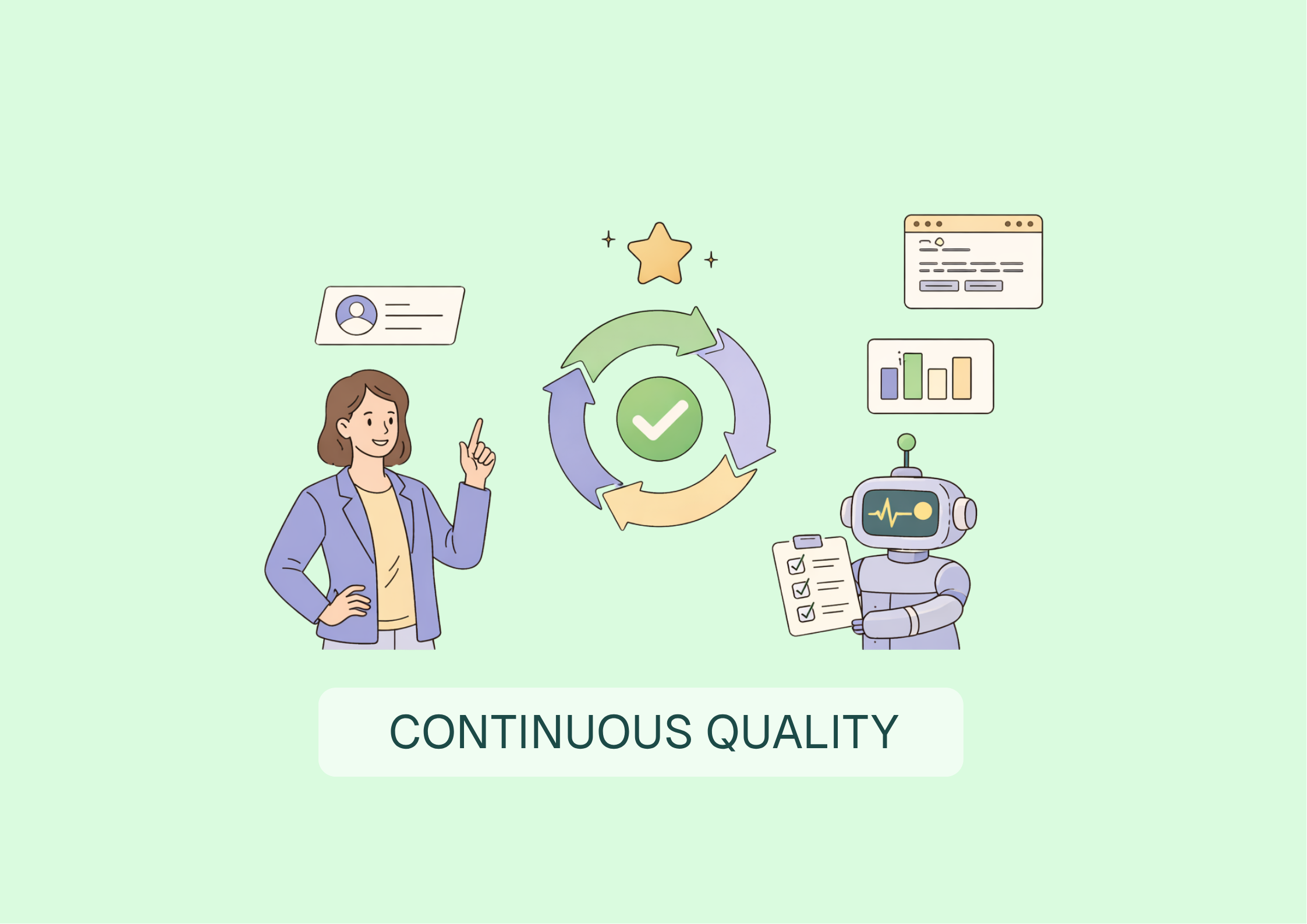
In a world where teams deploy multiple times a day and microservices architectures dominate modern stacks, software quality can’t be treated as an afterthought. Continuous Quality (CQ) is emerging as a strategic engineering practice that is reshaping how organizations design, build, and operate digital products.
Continuous Quality is an approach that measures, monitors, improves, and debugs quality throughout the development lifecycle. Instead of treating testing as a final gate, CQ evaluates quality with every change, creating a persistent feedback loop from code to production and back.
This shift addresses real business pressure. When software powers critical sectors like healthcare and finance, and when user experience directly influences revenue and retention, quality becomes a competitive differentiator. The question is no longer whether quality matters, but whether you can sustain it at speed.
Summary
1.
I. MEASURING: Understanding the Real State of Quality
2.
II. AUTOMATE: Detect Problems as Early as Possible
3.
III. IMPROVE: A Collective and Continuous Approach
4.
Continuous Quality: A Sustainable Competitive Advantage
5.
6.
7.
8
9.
10.
The software development landscape has changed dramatically in recent years, creating new obstacles to maintaining high quality standards.
Distributed complexity is the first major challenge. Microservices have replaced monoliths with dozens, sometimes hundreds, of independently deployed services. Teams ship changes autonomously, which improves velocity and scalability, but also makes it harder to understand system-wide impact. A minor change in one service can trigger cascading effects across the entire system.
Release velocity adds another layer of difficulty. When code reaches production multiple times per day, isolating which change introduced a regression becomes harder without strong traceability and correlation between deployments, performance signals, and incidents.</p>
Fragmented quality data is another common obstacle. Quality signals are scattered across the pipeline: unit test results in one tool, static analysis reports in another, performance metrics somewhere else. This fragmentation prevents a consistent view of product health and makes it difficult to spot trends, anticipate risk, or prioritize improvements.
Quality is not just the absence of bugs or adherence to style guidelines. The real measure of quality is the experience users have day to day.
Even “well-tested” code can still create friction if pages load slowly, interactions feel laggy, or features fail to match real user expectations. Continuous Quality should therefore include user-centered signals such as satisfaction scores, task completion time, drop-offs, and qualitative feedback.
The feedback loop becomes essential. Instead of waiting for support tickets or app store reviews, CQ encourages near real-time signals that reveal when a change harms experience even if everything looks “fine” from a purely technical perspective.
That’s why monitoring and observability in production are no longer optional. Quality needs to be validated under real conditions across real devices, networks, and usage patterns. This is where issues like performance regressions, device incompatibilities, and dependency side effects show up even when staging looks clean.
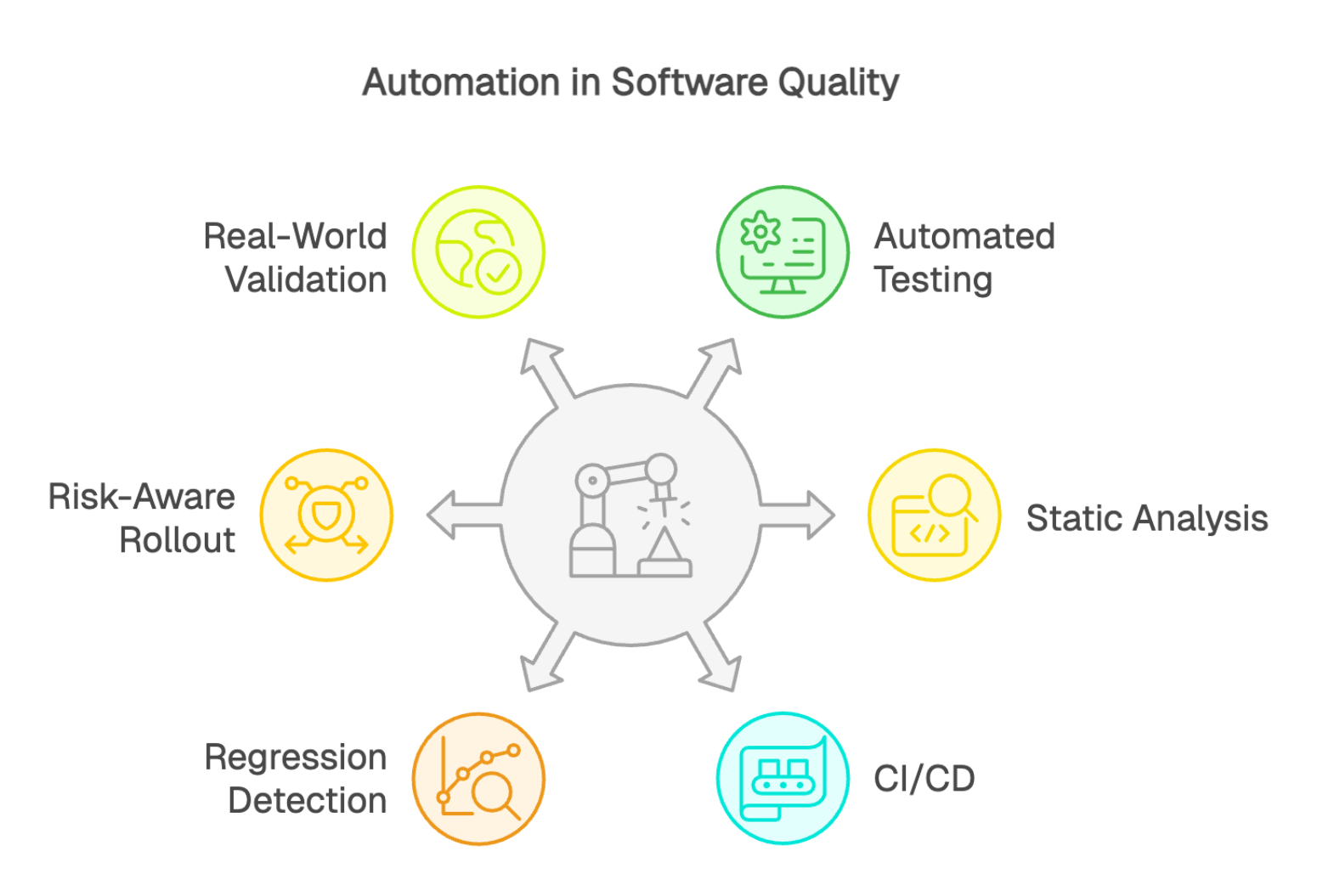
Automation is what makes Continuous Quality feasible at modern release speed. Without it, maintaining a high bar while shipping continuously becomes unsustainable.
Automated testing is the first line of defense. A strong strategy covers multiple layers: unit tests to validate local logic, integration tests to verify service interactions, and end-to-end tests to simulate critical user journeys. The goal isn’t automation for its own sake. It’s fast, reliable feedback that teams can trust.
Static analysis and code review catch issues before runtime. Linters and scanners can surface standards violations, excessive complexity, security risks, and risky patterns. Paired with peer reviews, these practices raise baseline quality before code ever ships.
CI/CD orchestrates the entire quality pipeline. Each change triggers a repeatable sequence: build, test, analyze, package, and deploy. That automation reduces manual error and makes outcomes reproducible across teams and environments.
Automation alone is not enough if you don’t understand the real impact of changes on the system.
Regression detection is essential when changes are frequent. Modern approaches compare signals before and after releases to identify regressions, including functional failures, performance drops, accessibility issues, or usability degradation.
Risk-aware rollout enables smarter deployment decisions. By assessing scope, blast radius, and dependency impact, teams can choose the right strategy: canary releases for risky changes, automatic rollback when thresholds are breached, or additional validation for high-impact features.
Real-world validation complements pre-release testing. Some issues only appear with real traffic patterns, real dependencies, and variable network conditions. Measuring QoE directly in production can surface friction early. Solutions such as Kapptivate help teams monitor real experience, detect regressions, and prioritize fixes before issues affect customer satisfaction at scale.
Continuous Quality breaks traditional silos. Quality cannot live in one team or one role.
Developers need to build quality in as they write code. Operations teams need quality signals embedded in deployment and monitoring workflows. Product teams need clear quality criteria aligned with user outcomes. UX teams need to account for experience tradeoffs. When quality becomes shared ownership, organizations move faster with less risk.
A quality culture requires more than process. It requires tooling that makes quality visible, accessible, and actionable. The goal is to remove friction so quality practices feel lightweight, fast, and effective rather than a burden teams try to bypass.
Continuous Quality also turns incidents into learning. Every failure becomes input: improve tests, refine alerting, adjust rollout strategies, and strengthen guardrails. Over time, this compounding loop increases resilience and reduces repeat problems.
This is one of the most important ideas behind Continuous Quality: deployment is not the finish line. It’s the start of real validation.
Post-release monitoring and real-time alerting are critical. Once live, software must be continuously observed for abnormal behavior: latency spikes, rising error rates, crashes, and experience degradation. These signals must be easy to access and act on so teams can respond before issues spread.
Incident review and learning are core to improvement. Each production issue should trigger a structured, blame-free analysis: what happened, why it escaped earlier detection, and which tests or guardrails could prevent a repeat. That learning strengthens the system over time.
Finally, user feedback closes the loop. Quantitative signals (usage, completion, drop-offs) and qualitative input should feed directly into future iterations. This direct connection between what users experience and what teams build is how technical quality becomes QoE.
Continuous Quality is more than an evolution in testing. It’s a shift in how software is built and delivered when speed and reliability must coexist.
The benefits are tangible: faster delivery without sacrificing stability, lower cost of fixes by catching issues earlier, improved customer satisfaction through smoother experiences, and reduced deployment risk through better validation and rollout control.
A holistic approach matters. Continuous Quality works best when it connects code quality, infrastructure resilience, and real user experience into a single operating model. That end-to-end view, from commit to production reality, is what creates durable advantage.
In competitive markets where users have high expectations and endless alternatives, Continuous Quality is not a luxury. It’s a strategy. Organizations that treat it as a culture, not a checklist, are the ones that will keep shipping value while protecting trust.
Quality is rarely accidental. It’s the result of clear intent, disciplined execution, and continuous vigilance. Continuous Quality provides the framework and tooling mindset to make that intent operational at scale.