


.svg)

.svg)


Testing
Step-Level Validation: How to Move Beyond Pass/Fail on Your Synthetic Tests



Automated testing to validate user experiences across real devices, networks, and channels.
 Blog
Blog

.webp)
The acceptance test specification is a fundamental document in the world of software development and project management. It brings together all the scenarios and validation criteria that will serve as the basis for acceptance testing. Its purpose is to verify that the deliverables comply with the initial requirements of the client or end user.
This crucial step usually takes place in the final phase, just before production, when the product must be rigorously tested to ensure that it fully meets the expectations defined in the specifications. The QA tester plays a key role in this process, using their expertise to guarantee the reliability and relevance of each test carried out.
The acceptance test specification is essential because it centralizes the checks to be carried out before delivery. These tests make it possible to detect and correct critical anomalies to guarantee the quality of the final product.
Summary
1.
Understanding the acceptance test specification
2.
Different types of tests
3.
Methodology : how to write a test specification in 6 steps
4.
Typical structure of an acceptance test plan
5.
Test execution and monitoring
6.
The advantages of the acceptance test book
7.
Best practices and recommendations
8
Summary : why the acceptance test plan is essential
9.
10.
The acceptance test specification is a validation document that serves as a comprehensive checklist. Its main purpose is to confirm that the results of the tests carried out on the deliverables correspond exactly to the functional specifications established during the design phase.
Unlike unit or integration tests, which are carried out during development, acceptance tests mark the final stage before delivery to the customer.
The acceptance test specification is derived directly from a predefined acceptance strategy, which describes the general context, the test methodology, and the persons authorized to approve the results.
The fundamental objective of the test specification is to ensure that the developed product is robust, reliable, and perfectly matches the customer's requirements. These tests are an absolutely essential quality assurance measure for any organization concerned with maintaining its reputation.
A product delivered with errors can have disastrous consequences for customer confidence. To illustrate this problem, the example of Apple in 2017 with ‘Battery Gate’ perfectly demonstrates the risks involved. Following an iOS update, many iPhone users noticed a significant drop in the performance of their devices. This situation caused a major crisis of confidence, leading to several lawsuits and a discounted battery replacement program that cost the company several million euros.
The acceptance test specification helps to avoid post-production disappointments by comprehensively listing all use cases to be verified in advance.
The acceptance phase relies on the acceptance test specification to validate that the delivered product meets the expressed business needs. Several categories of tests are documented in this specification.
Functional tests are at the heart of the acceptance test book. They verify that each developed feature corresponds precisely to the business specifications defined upstream. For example, we will test that an order form contains all the required fields and that the validation rules apply correctly.
Business integration tests verify that the various modules of the system interact correctly in complete scenarios. The objective is to ensure that data flows smoothly between components. For example, testing that a validated order triggers the updating of stock and the generation of an invoice.
End-to-end tests simulate real user journeys from start to finish. They reproduce real-life conditions of use to validate the entire experience. For example, following the entire customer journey from browsing the catalogue to receiving the order confirmation email.
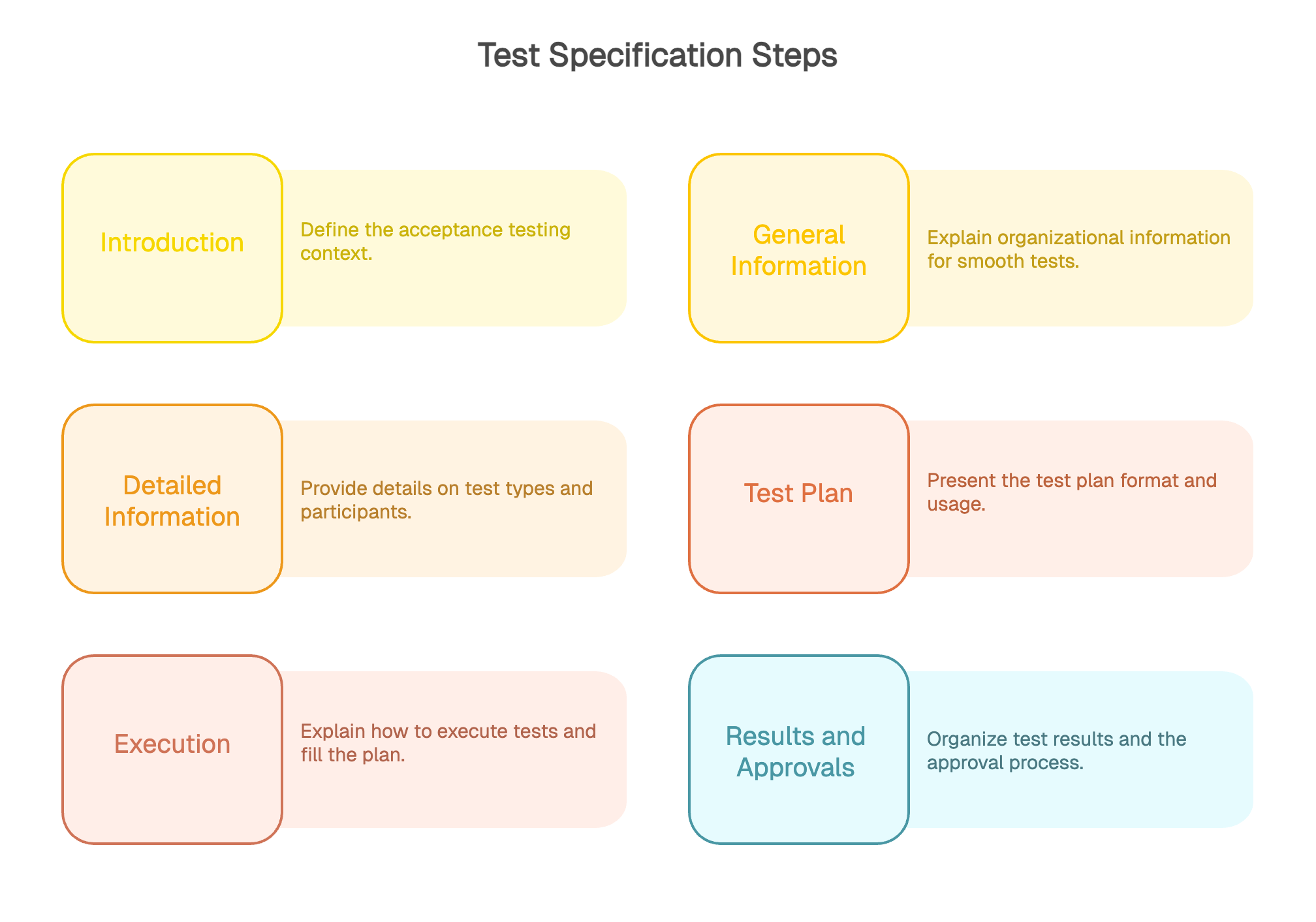
The first section must clearly define the acceptance testing context in which the tests will be carried out. This introduction presents the general objectives, the scope of the project concerned and the specific issues related to this validation phase.
This section explains the general organizational information necessary for the tests to run smoothly. It specifies the roles and responsibilities of each participant, the technical and human resources mobilized, and the general planning of the test sessions.
The third section provides detailed information on the types of tests to be carried out and the people involved in the process. It specifically identifies the testers, validation managers and final decision-makers.
This section presents the format of the test plan and explains its practical use. It details the structure of the test scenarios, the acceptance criteria and the procedures for documenting the results.
The execution stage explains in concrete terms how each part of the tests will be carried out and how to correctly fill in the plan with all the relevant information. It specifies the execution procedures and reporting standards.
The final stage summarizes the test results obtained and organizes the official approval process. This section formalizes the compliance of the deliverables with the initial specifications.
An effective acceptance test plan template must follow a logical and comprehensive structure. The document begins with an introduction presenting the objectives and scope of the tests, followed by a section dedicated to the test strategy, which describes the technical environment and the necessary resources.
The central part contains all the test cases, each of which describes in detail the prerequisites, the steps to be followed, the input data and the expected results. These test scenarios must cover both successful cases and potential failure situations.
A monitoring and reporting section is used to document the results obtained for each test, identify any anomalies detected and track the corrective actions taken. This traceability is an essential element of quality management.
Finally, the conclusion of the document presents a summary of the results, recommendations for the rest of the project, and formal approvals from stakeholders.
The implementation of the test plan requires rigorous preparation of the execution conditions. This phase involves setting up the appropriate technical environment, gathering all the necessary resources, and coordinating the various parties involved.
The execution itself must guarantee the uniqueness and traceability of each series of tests. Each test performed must be accurately documented, including the execution conditions, the results obtained, and any anomalies found.
Incident management is a crucial aspect of this phase. When malfunctions are detected, they must be recorded with all the details necessary to enable their reproduction and correction: reproduction steps, screenshots, environmental conditions.
The final approval process takes place once all tests have been completed and all critical anomalies have been resolved. This step formalizes the validation of the product and authorizes its release into production.
The systematic use of an acceptance test book provides many tangible benefits for organizations. The first advantage is improved product quality. A product that has been rigorously tested according to a structured methodology naturally presents less risk of malfunction in production.
Transparency is the second major benefit. Testing the product in collaboration between developers and customers makes it possible to detect potential misunderstandings or implementation errors early on. This collaborative approach also helps to bring teams together and create a climate of mutual trust.
Risk reduction is a third significant advantage. The acceptance process significantly reduces the risks usually associated with the development of new products or services. This risk reduction translates into substantial savings and preservation of brand image.
Finally, compliance with ISO 9001 standards is an additional asset. Test plans and their results provide documented evidence that can be used during quality audits to demonstrate that all means are being implemented to deliver a product that meets requirements under optimal conditions.
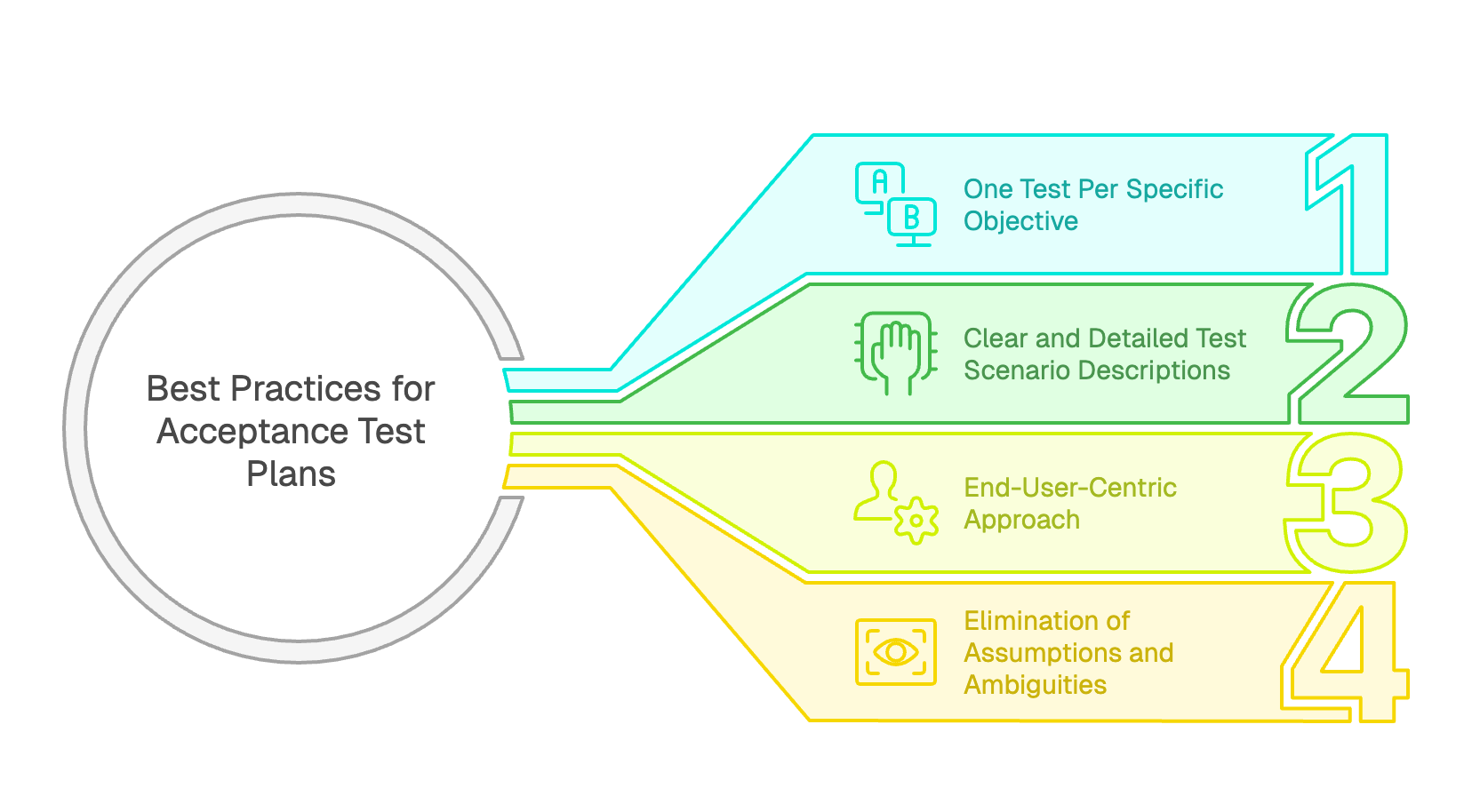
To maximize the effectiveness of the acceptance test plan, several best practices must be followed. The fundamental rule is to create one test per specific objective. This approach ensures accurate results and facilitates the identification of malfunctions.
Clear and detailed test scenario descriptions are a key factor for success. Tests must be formulated in understandable language, avoiding obscure technical terms or ambiguous steps that could be misinterpreted.
The end-user-centric approach must guide test design. It is essential to keep in mind that the ultimate goal is to improve the end-user experience. Test cases must therefore accurately reflect the actual conditions of use of the product.
The elimination of assumptions and ambiguities is an absolute requirement. When information is unclear, it is imperative to consult with the relevant team members to obtain the necessary clarifications, rather than making assumptions that may prove to be incorrect.
The acceptance test plan is an essential part of any development project. The financial stakes associated with production errors can be considerable, as illustrated by recalls in the automotive industry, which regularly cost manufacturers several million pounds.
The impact on customer confidence cannot be overlooked. A single error in a product that goes into production can permanently damage the commercial relationship and harm the company's reputation. The acceptance test report is the best defense against this type of risk.
The durability and archiving of the document also offer long-term benefits. The acceptance log, updated at each major test phase and kept in the project archives, is a valuable knowledge base for future product developments.
Ultimately, investing in a structured and rigorous acceptance process is much more than a simple administrative formality. It is a quality investment that protects the company, reassures customers and guarantees the sustainability of the solutions developed. A well-designed plan significantly increases the chances of delivering a robust and reliable product while creating a climate of lasting trust between all project stakeholders.


